News Updates
Professor Andrey S. Vasenko of the HSE University Visits GIEC
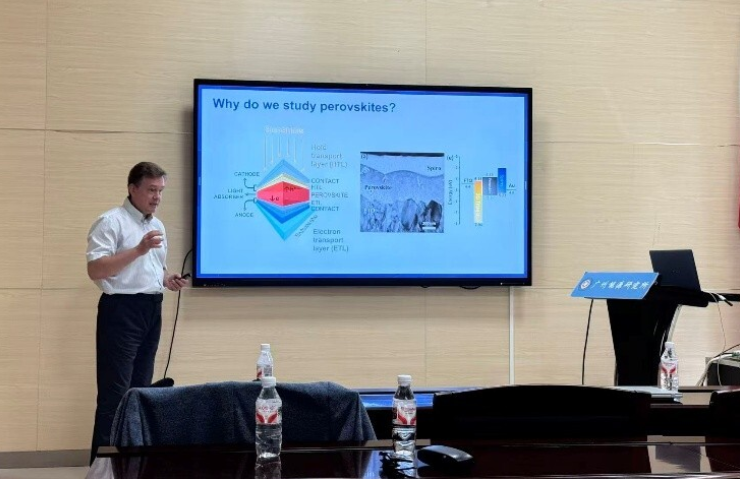
On November 2, at the invitation of the solar energy research team at the Guangdong Provincial Key Laboratory of Renewable Energy and the Offshore Energy Research Center, Professor Andrey S. Vasenko from the Higher School of Economics (HSE University) visited the Guangzhou Institute of Energy and delivered an academic lecture. Researchers and graduate students in related fields attended the lecture and participated in academic exchanges.
Centered on the theme of “Grain Boundary Engineering in Metal Halide Perovskites,” Andrey S. Vasenko focused on the core scientific challenges in enhancing the performance and long-term stability of perovskite solar cells. Drawing on his team’s research involving first-principles calculations and machine learning-based force field simulations, he provided a detailed account of spontaneous slip and significant distortion of grain boundaries in the CsPbBr₃ system on the nanosecond timescale, transient trap states generated by lead–lead interactions that induce nonradiative recombination, and representative atomic-scale mechanistic findings—such as grain boundaries serving as preferential migration pathways for bromide ions and the enhanced ionic mobility resulting from substoichiometric local environments. He also elucidated the physical control strategy of compressive strain engineering: Compressive strain stabilizes the grain boundary structure and eliminates charge traps; by inducing lattice tilt, it transforms the grain boundaries into a dense, quasi-amorphous phase, thereby suppressing ion migration and achieving synergistic optimization of device stability and performance.
This academic presentation provided the solar energy research team and relevant researchers with a platform for in-depth exchange on cutting-edge theoretical advances in perovskite grain boundaries. It will help promote academic exchange and collaboration at the institute in the fields of perovskite photovoltaics and advanced optoelectronic materials, thereby further enhancing the level of research.