

Research Areas
The team focuses on key challenges in building a new energy system under China’s “Dual Carbon” goals of carbon peaking and carbon neutrality. Centered on three integrated research directions—digital energy, technology assessment, and carbon assets—the team promotes the deep integration of digital technologies with energy systems. It explores coordinated coupling mechanisms among ecological systems, energy systems, and carbon markets, as well as pathways for realizing the value of carbon assets. Through these efforts, the team aims to provide both theoretical foundations and practical solutions for developing a clean, low‑carbon, secure, and efficient new energy system. The team also supports enterprises in making informed green and low‑carbon decisions, cultivates high‑level talent in the field of carbon neutrality, and actively advances international collaboration, contributing Chinese perspectives and solutions to the global energy transition.
The team’s core research areas include digital energy systems, assessment of low‑carbon and zero‑carbon technologies, carbon asset management and carbon markets, and technical services for energy conservation and carbon reduction. It has developed a distinctive research profile characterized by the deep integration of “soft science” (policy, economics, and management research) with “hard technology” (engineering and technological innovation). The team brings together interdisciplinary expertise spanning energy engineering, economics, management, policy, and finance. It currently comprises 29 staff members and 39 master’s and doctoral students, including 6 senior researchers, 7 associate senior researchers, and 12 mid‑level researchers. Led by Chief Scientist Academician Chen Yong, the core academic members include researchers Zhao Daiqing, Cai Guotian, Liao Cuiping, Wang Peng, Wang Wenjun, and Huang Yuping. The team possesses strong capabilities in scientific research, strategic policy support, and integrated technical services.
During the 15th Five‑Year Plan period, the team will address emerging application scenarios and industrial upgrading needs, including low‑altitude aviation–vehicle–grid integration, offshore energy islands, zero‑carbon rural communities, and zero‑carbon industrial parks. With the goal of developing “AI+” intelligent energy systems, the team will employ key technologies such as multi‑source integrated sensing, digital twins, artificial intelligence, energy foundation models, and autonomous optimization and decision‑making. These efforts aim to build an integrated data infrastructure, model system, and simulation platform for air–land–sea energy systems, and to establish large‑scale demonstration projects for intelligent energy applications across multidimensional scenarios.
Key Research Areas
The team focuses on research in digital energy system modeling and intelligent decision‑making, life‑cycle system evaluation and technology development pathways for low‑carbon and zero‑carbon technologies, carbon asset management and carbon market mechanisms, as well as integrated technical services for energy conservation and carbon reduction. Through these efforts, the team has established a comprehensive research framework integrating digital energy, technology assessment, and carbon asset management, forming a coordinated “Digital Energy–Technology Evaluation–Carbon Assets” research structure.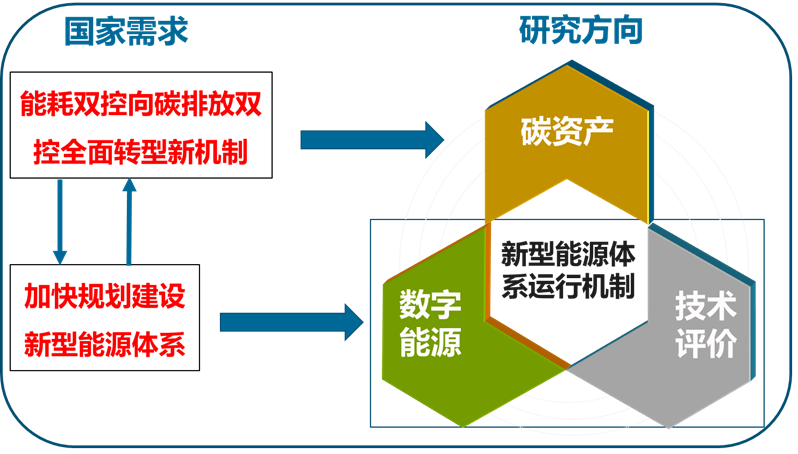
Research Directions of the Energy Strategy and Low‑Carbon Development Team
Core Researchers
CHEN Yong
ZHAO Daiqing
CAI Guotian
LIAO Cuiping
WANG Peng
WANG Wenjun
HUANG Yuping
Key Research Platforms & Facilities
Relying on high‑level scientific and technological innovation platforms of the CAS, the team has established and participated in the development of several research and application platforms related to digital energy, electricity–carbon coupling, and low‑carbon management. It holds multiple professional qualifications, including designation by the Guangdong Provincial Development and Reform Commission and the Department of Industry and Information Technology as one of the first accredited third‑party carbon emissions verification institutions, Class‑A certification for energy‑saving technical services, and qualifications for energy conservation assessment of fixed‑asset investment projects.
The team has also taken the lead in establishing three joint industry–research laboratories on electricity–carbon metrology and digital energy, participated in the construction of the Guangdong Provincial Energy Economy Data Platform, and developed a high‑precision regional renewable energy resource database.
Signature Achievements
1. Publications and Monographs
In recent years, the team has published more than 160 papers in SCI, EI, and other core academic journals, including over 90 SCI‑indexed papers. The team also has authored and published 31 academic monographs in China and abroad.
2. Invention Patents, Software Copyrights, and Standards
The team has been granted 18 invention patents and 2 utility model patents, and has filed 3 international PCT invention patent applications. It has also obtained more than 10 software copyrights and led or contributed to the development of more than 10 group standards.
3. Regional Energy System Intelligent Management
Led the design and multi-module development of the "Guangdong Province Energy Economic Data Platform." The results have been rated as internationally advanced by the China Electrotechnical Society and the China Electricity Council, and have been used to support the Guangdong Provincial Development and Reform Commission's Energy Bureau.
4. Energy-Transport Integration Smart Decision-Making
Focused on optimizing the collaboration between electric vehicles and regional integrated energy systems. Developed a full-chain smart decision-making technology for "travel patterns - potential evaluation - control optimization," and established a theoretical framework for the vehicle-network interaction value network. Independently developed and built a V2G resource aggregation smart control platform, addressing peak-shaving, virtual power plants, and local renewable energy consumption needs in urban office parks.
5. Energy-Carbon Coupling and Carbon Footprint Demonstration Applications
Led the establishment of joint experimental laboratories on energy-carbon measurement and digital energy, and applied the results to industries such as energy equipment manufacturing, high-energy-consuming enterprises, and the battery manufacturing sector.
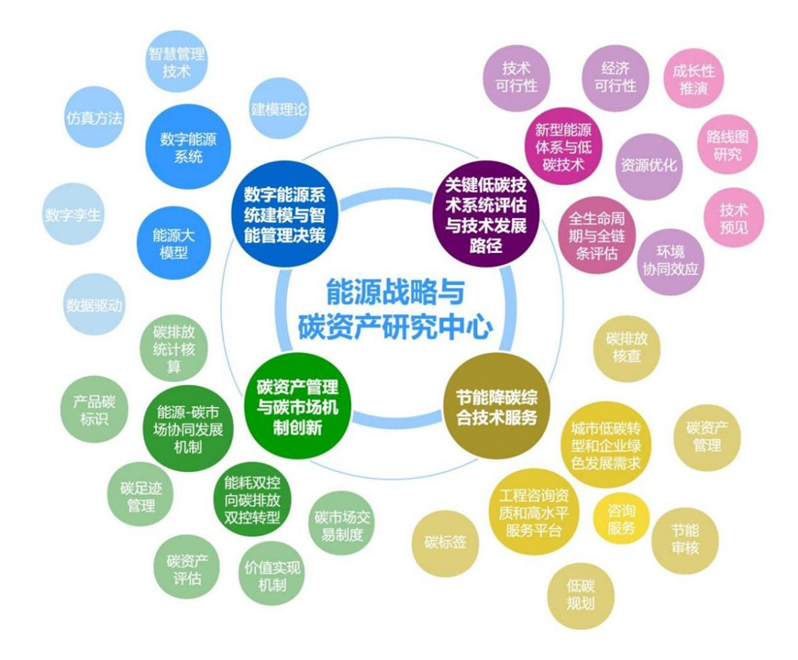
Major Research Activities of the Team
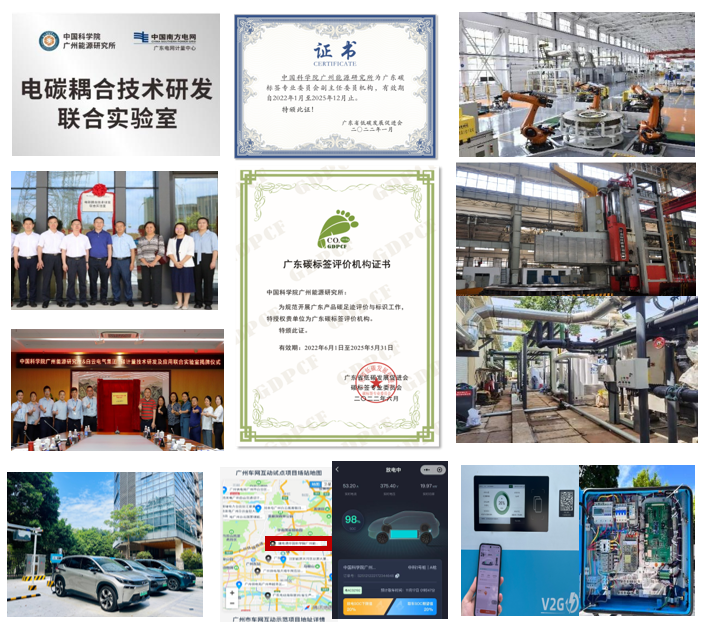
Application of Research Outcomes Caption
International Collaboration
The team actively promotes international collaboration to explore China’s distinctive pathway for energy transition—characterized by large scale, complex pathways, and far‑reaching impacts—and contributes new ideas and approaches to the global energy transition. It also supports energy system development in Belt and Road Initiative (BRI) countries through research on large‑scale photovoltaic deployment, green trade barriers, and carbon labeling systems. Related projects include promoting large‑scale PV development in BRI countries through digital energy technologies and low‑carbon policy innovation.
Team members have extensive international research experience, with visiting or collaborative research in Japan, the United States, Switzerland, and the United Kingdom. The team has undertaken China–Switzerland and China–US cooperative projects and maintains partnerships with organizations such as the World Bank, Asian Development Bank, the European Commission, the UK Foreign, Commonwealth & Development Office, and the German Federal Ministry for Economic Cooperation and Development, supporting research and policy advisory work on low-carbon transition and institutional design.
Contact Name& Email
Cai Guotian, Director of the Center
caigt@ms.giec.ac.cn
Wang Peng, Deputy Director of the Center
wangpeng@ms.giec.ac.cn
Huang Yuping, Deputy Director of the Center
huangyp@ms.giec.ac.cn